The film · v43:52 · 1920×960 · 30 fps51 shots · her lips follow the voice in 27 of them179 takes · 51 shots · 1 song
The whole song, shot by shot. Point at a shot; click to play from there.
01 · The song
3:44, one voice and one guitar.
The same song as the first film, recorded again. This is the page of the acoustic film: the film, every shot, how it was made.
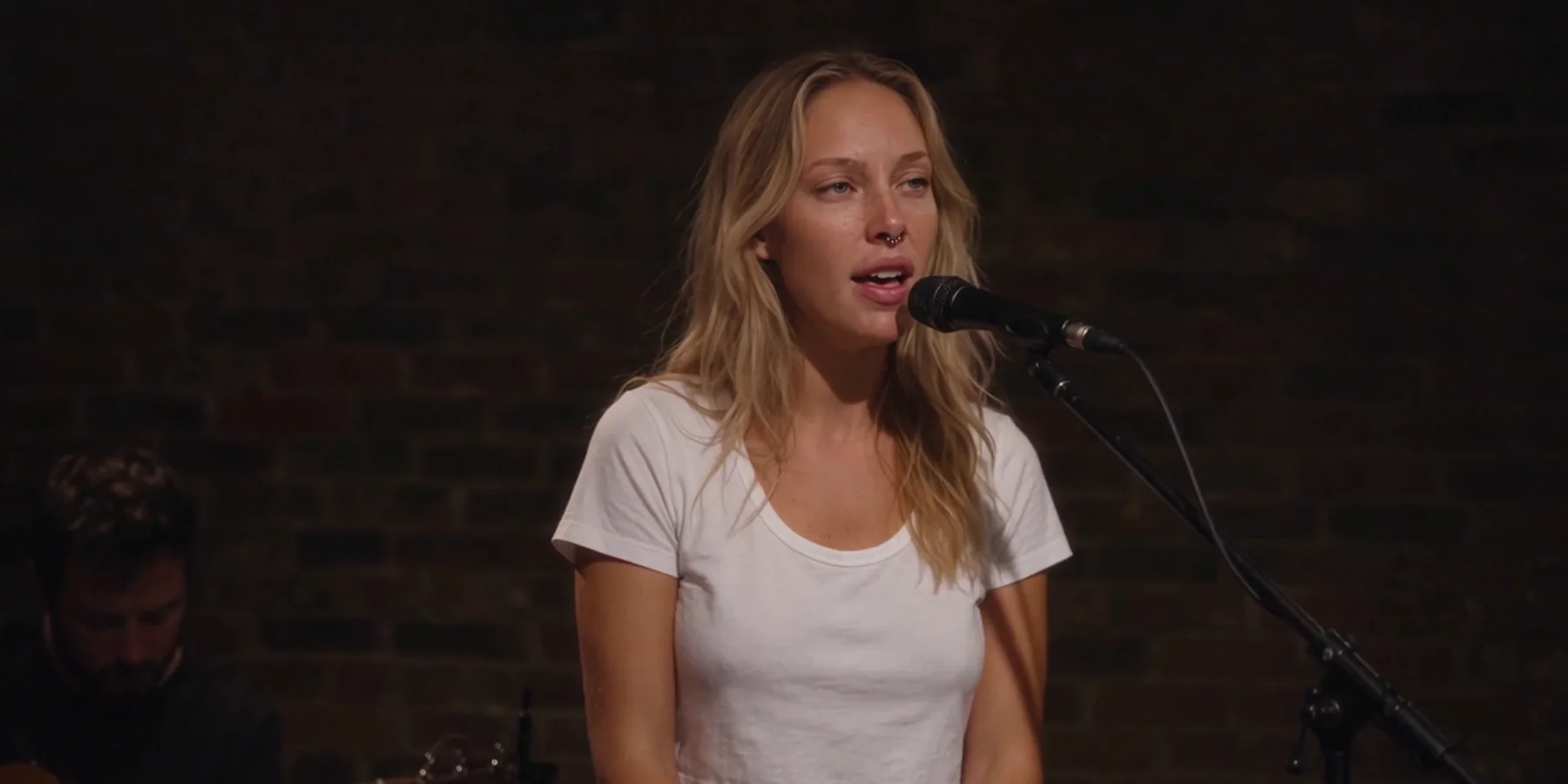
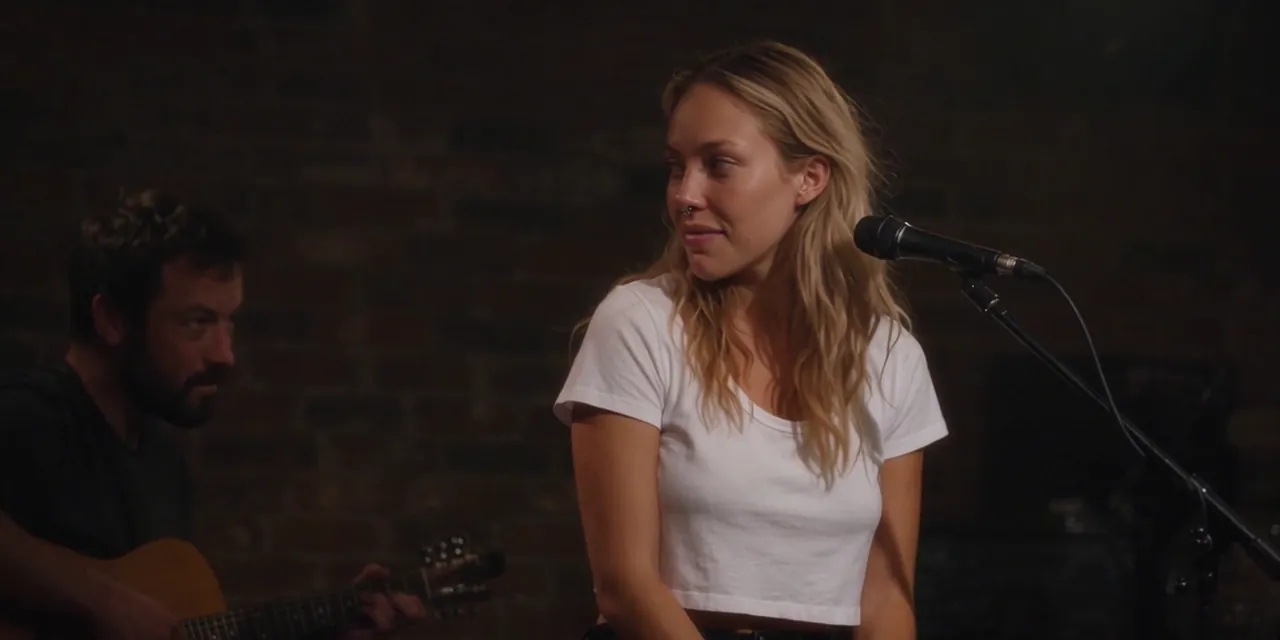
The same song, sung again with one acoustic guitar. A small bar at night: she sits on a tall stool, the guitarist low beside her, a few listeners in the dark. Before the first line she turns to him and smiles a little; he looks up and nods.
The film is shot as if by a handful of fixed cameras in one room, so the stage, her clothes and the light never change. Where the voice climbs highest the film looks away from her lips: to her back, to the listeners, or to her face in slow motion.
The film follows the song part by part. Click a part to play from there.
03 · Shot by shot
51 shots.
Every shot in the film with its camera, its seed, what it was given, what was measured and the prompt as it was sent.
Wan 3.0 · waist up1920×960 · 30 fps
Prompt, as sent
The first reference image shows the face of the blonde woman from four sides and is only for her identity: keep exactly this face, the dense freckles, her one septum ring (shown in the third reference image), the deep blue-grey eyes and the long wavy dark blonde hair with copper in it, darker at the roots, for the whole take; do not take clothes or background from it. The second reference image shows the stage of this film as the wide camera sees it from the room: the same singer on the same tall wooden stool in the middle, her white cropped t-shirt, black jeans and plain white sneakers; the microphone on its stand at her left side (at the right in that image), its arm reaching to her mouth; the guitarist sitting low at her right side (at the left in that image) in dark clothes with his acoustic guitar; the dark brick wall; the black shapes of listeners in the foreground; the dim light and the dark muted colours. In every take of this film the stage, the people, the clothes, the light and the colours are exactly these and nothing changes place. The third reference image is a very close view of her nose and is only there to show her one piercing exactly as it must look in every frame of this take: one small CLOSED silver ring hanging from the middle of her nose, between the nostrils, with a row of seven tiny round silver beads along its lower curve, the middle bead a little larger than the others. It is one complete ring: not a horseshoe, no open ends, no two balls at its ends, no plain ring without beads. There is nothing on her nostrils and no other jewellery on her face. Never show the picture as close as that reference; take only the ring from it. Night, inside a small dim bar. This take is filmed by another camera, fixed, that stands in the room much nearer to the stage than the wide camera of the second reference image, in front of her and a little to the left, at the height of her chest, on a long lens: a waist-up shot, much closer than the second reference image. The lower edge of the picture cuts her at the waist: her legs, the stool and the floor are NOT in the picture. Her head is in the upper part of the picture with a little dark wall above her hair; she sits a little right of the middle and her face takes about one quarter of the height of the picture, turned a little toward the right edge. Her hands rest in her lap, below the lower edge. She wears the white cropped t-shirt of the second reference image, never any other top. The first frame is already exactly this framing: no fade, no dissolve and no double image. The black microphone on its stand comes in from the right, ending a hand's width in front of her lips and a little below them. At the left side of the picture, lower than her and half a step behind her, the guitarist sits bowed over his acoustic guitar in shadow, a little out of focus: only his head, his shoulders and the upper part of his guitar are in the picture, his head at the height of her chest. No listeners are in the picture. Her long wavy hair hangs loose over her shoulders; on the side of the guitarist it is tucked behind her ear, so that this ear, her jaw line and her neck are bare. No music yet: nobody plays and nobody sings. Second 0 to 0.8: she sits still on the stool, her head lowered toward the microphone, her eyes down. Second 0.8 to 1.6: she turns her head and her shoulders to her right, toward the guitarist at the left of the picture, and looks at him. Second 1.6 to 2.8: looking at him, her face softens: a small, warm, easy smile comes with closed lips, the corners of her eyes crease, and she gives him one slow, relaxed blink with a tiny nod, the way one says "ready?" to a friend without a word. It is light and quick, not posed. Second 2.8 to 5: she turns back to the microphone; the smile fades into a calm face, she lowers her eyes and draws a slow breath in, her shoulders rising. The guitarist stays bowed over his guitar in shadow for the whole take, his face down and hidden by his hair; he does not look up in this take and his hands are still. Nobody sings and nobody speaks in this take. The black microphone stays fixed on its stand in the same place; nobody touches it. The camera is fixed and never moves: no zoom, no pan, no cut. The framing is the same from the first frame to the last and nothing enters the frame. She does not look into the lens of the camera. One continuous take, real-time speed. Filmed like a feature film on a large-sensor cinema camera with a fast prime lens: shallow depth of field, soft falloff of focus, gentle roll-off in the highlights, deep blacks that still hold detail, natural skin tones, fine film grain. Very dim: one soft warm light from high up in front of her, a little from the side of the guitarist; no lamp and no light source is seen; her face is the brightest thing in the picture; dark, muted colours of low saturation. Real skin with pores and freckles, small creases where the face tightens. Sound: only a quiet small room at night: the low hush of a few people waiting, a chair creaks once, a breath. No music, no guitar note, no singing, no speech.
Shot 01 / 510:00 · 3.1 s
She turns to him
Time
0:00 · 3.1 s on screen
Camera
fixed, in front of her at chest height: waist up, the guitarist in the shadow at the left
Take
Wan 3.0 · 720p · 5 s take · seed 6801
Given
face sheet + stage still + ring card
Face
0.68 median · 0.58 lowest · face 293 px · measured in the cut
Cost
$0.30 · generated in 139 s
Made
17 Nov 2026, 21:16
Note
Before the song: nobody sings or plays yet. Shot at 720p and enlarged to the size of the film.
her lips follow the voice in this shot · 27 of 51
04 · How it was made
179 takes for 51 shots.
From the first trial take to the last one, 33 hours. The numbers below include every take that was thrown away and the trials before the full shoot.
179
takes generated2 more requests never went through
51
shots in the filmcut from 51 different takes
99 / 124
seconds with her lips on the voiceof the seconds where they can be read · audit of v3
$113
spent on takes$29.99 of it is in the film
01
The decisions first
A first idea, the same song sung on a street, was shot before the decisions were clear, looked artificial and was dropped. The second idea was a closed, dim room with few people. This time the place, her clothes, the cameras and the look were agreed in writing before the full shoot.
02
The song, measured
Every word of the recording was timed. Then a map of how each phrase is sung: breathy, soft, full, belted, hummed, with the jumps, the cracks and the long notes. The guitar strokes were read off the instrument channel.
03
The room and the cameras
One still of the stage, and stills of the room as seen from the stage. Every camera is a paragraph of text that starts from one of those stills, which is why the stool, the microphone stand and the guitarist stay where they are. The face sheet and a close card of her ring go into every take with her face.
04
The takes
A take is a few seconds long, most often five. A take in which she sings to the camera gets the vocal of exactly those seconds and one feeling. Its prompt is written from the singing map, second by second.
05
Hard notes, other cameras
On long high notes the generated lips do not hold to the voice. Those seconds are filmed where lips cannot be read: from behind, on the listeners, or as a face in slow motion. Slow motion is made in the cut from a take shot at normal speed, and only where the lips are not tied to the sound.
06
The cut
The whole film is one file: every shot with its camera, its seconds, its take and its seed. Changing a shot is one line and a few commands, and only the parts that changed are rendered again.
07
The audit
The finished cut is checked against the song second by second: is there a face, is it hers, what is the mouth doing, do the lips sit on the voice. The first cut went to the director without this, and he found what the audit would have found.
Three video models were tried. One carried the film.
Film: Wan 3.0. Stills: Seedream 5.5. Measuring: InsightFace (as an internal ruler only), SyncNet, Demucs, faster-whisper, librosa, OpenCV. Cut: ffmpeg, with motion-estimated frames for the slow motion.
Wan 3.0
174 takes · $111.25
HeyGen Avatar IV
3 takes · $0.78
Wan 2.7
2 takes · $1
720p
99 takes
1080p
80 takes
All takes
179 takes · $113.03
05 · The cuts
Four cuts in one day.
Each cut was watched by the director and answered with notes. The agent that builds the film cannot watch it or hear it; it works from frames and measurements.
Cut · 17 November 2026
The director’s note
What changed
v102:22
Finish the whole clip. Build it so that any shot or sequence is easy to revise later. It should not start on the first word, and the picture should be very good.
The first full cut: 48 shots from fixed cameras, starting 5.6 seconds before the song. In 74 of the 175 seconds where her lips can be read, they sat on the voice.
v212:43
I watched it and there are many errors. You did not compare every sequence with the song second by second. Side shots should be rare. Film the hard places from behind, and the high rises from behind in slow motion.
A second-by-second audit of the film itself. The hardest seconds moved to cameras where lips cannot be read; side shots cut down. Lips on the voice: 82 of 121 readable seconds.
v318:23
Far too long from behind. The slow motion does not look slow. The same two listeners appear three times. The first line should be sung from the front. No cut in the middle of a word. The look between the two of them at the start.
Slow motion made in the cut instead of asked for in the prompt. A different group of listeners each time. The opening and the first line shot again. Lips on the voice: 99 of 124 readable seconds.
v421:46
Only the sequences I name, not the whole clip. Real-looking people filming with their phones. A natural nod at the end instead of the kiss. In slow motion, the moment her voice is at its very top. A slight smile at the start; the guitarist still looks at someone else.
Those places and nothing else: the opening as a shot and a counter-shot, slow motion on the peak of the note, two groups with phones, the nod. 51 shots.
Locked22:06
This clip is finished. It has errors and I accept them. We should take lessons from this one and from the first film.
Nothing. The film was closed at v4.
06 · What is still wrong
Twelve known flaws.
The film was closed with these in it. They are listed so that the next one starts from them.
01Lip sync. In the 124 seconds where she sings and her lips can be read, they sit on the voice in 99. In 7 they run a few frames early or late, in 16 the reading is weak, and in 2 they do not hold.
02The last cut was not audited again second by second. The shots it changed have no lips tied to the voice, so the counts above are from the cut before it.
03The hummed passages (1:35, 3:35 and 3:43). Her lips should be closed there; in several of those seconds they stay slightly parted.
04The slow-motion faces hold a single mouth shape, and the teeth are a little soft. The shots at 2:53 and 3:26 are two parts of the same take.
05Seen from behind, the listeners in the room barely move.
06The guitarist's fretting hand is never shown close. A generated hand cannot be matched to the notes of a real recording, so the film does not show it. At 0:03 his hand moves on the strings a moment before the first guitar note.
07The shots at 2:50 and 3:22 come from an earlier take of the room, lit a little brighter than the rest.
08In the waist-up shots her ring is faint, and her T-shirt runs longer in places than in the close shots.
09The two shots of listeners with phones (3:18 and 3:40) are framed alike: three people, the one on the left filming. The people are different.
10Two side shots follow each other at 0:34 and 0:40.
11Face match. Of 493 measurements in the finished cut, 4 are under the threshold (0.47; 0.45 in profile). A singing mouth and closed eyes pull the number down.
12Of $113.03 spent on takes, $29.99 is in the film. The rest went to takes that were measured and thrown away, and to trying the method before the full shoot.